
Hungry Balls
HYPERCELLPuzzle
4.6207.00 Reviews
- Version
- 1.8.1
- Installs
- 5.00M
- Age Rating
- Teen
Screenshots
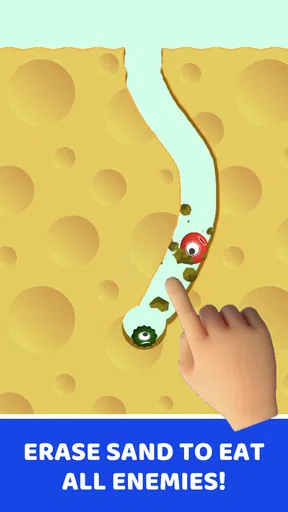
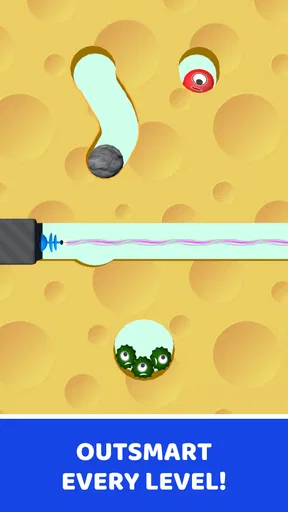
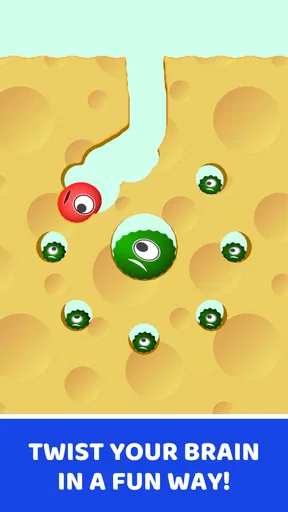
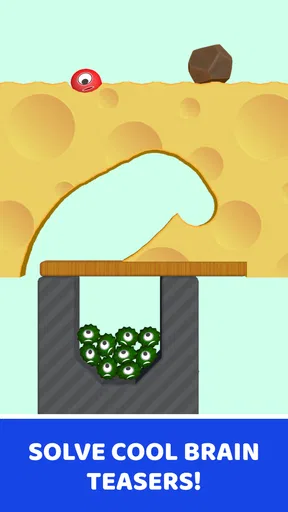
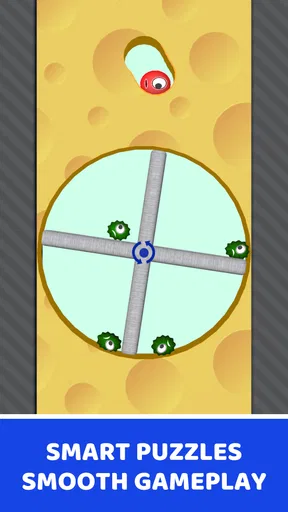
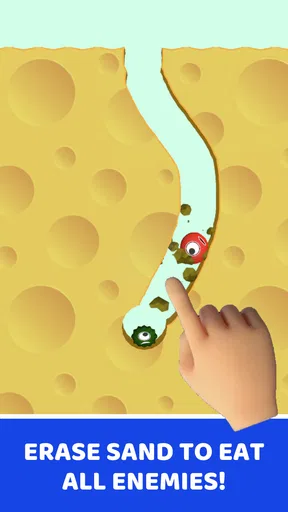
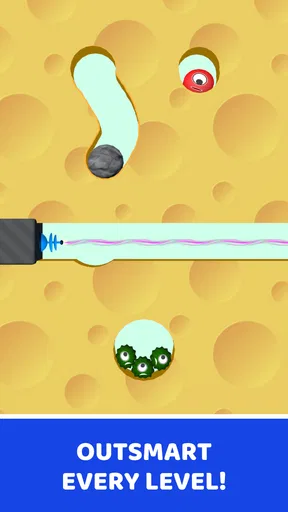
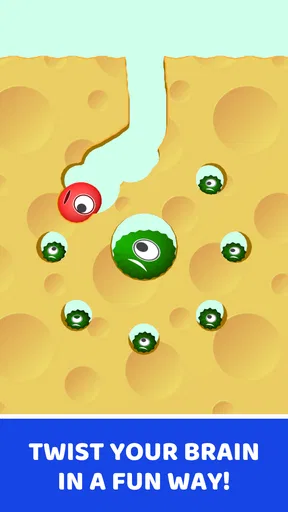
Our Review of Hungry Balls
 Analysis by Appyee
I spent time with Hungry Balls as a casual puzzle game, and its central idea is immediately easy to understand: remove sand so the hungry balls can reach what they need to eat. That simple setup gives the game a playful physics focus, but the real appeal is in deciding what to erase first, where falling objects will travel, and how to avoid turning a promising solution into a messy failure.
This is a free game from HYPERCELL in the puzzle category, aimed at players who enjoy short brain teasers rather than long story campaigns or complicated controls. It carries a Teen content rating, runs on Android versions 7.0 and later, and the current version is 1.8.1. The game reached release on April 2, 2026, and its store presence has already attracted over 5 million installs, with a 4.6 average from around 28 thousand ratings.
How Hungry Balls turns sand into a puzzle board
The basic interaction is the whole reason to try it. Instead of moving a character through a level with a virtual joystick, I erase sections of sand and watch the objects above respond to the newly created space. The balls are hungry, so the goal is not simply to clear a path. I have to think about the order of my actions and how gravity or momentum may change the result.
That distinction matters. A level can look obvious at first glance, yet a small cut in the wrong place can send a ball away from its target or block the route that seemed safest. The game therefore sits between a drawing puzzle and a physics puzzle. It is more tactile than a traditional tile-matching game, but less demanding than a full logic title built around large chains of rules.
I like that the premise creates an immediate visual question: where should I erase, and what will happen afterward? There is no need to learn a large collection of buttons before reaching that question. The design is suited to quick sessions because the interaction is direct, while the physics gives each move enough uncertainty to keep the solution from feeling like simple tapping.
The short description calls the game “Hungry Balls,” but the more useful way to understand it is as a sand-erasing challenge with hungry moving pieces. The balls are not just decoration. Their position, the available sand, and the destination all influence the correct approach. That makes the game specific enough to reward observation, even when a level itself takes only a brief moment.
What I pay attention to before making a move
My first habit is to pause before touching the screen. I look at the entire arrangement, identify the ball that seems most vulnerable, and then imagine how the sand will behave after the first opening appears. This is more reliable than immediately drawing a large path. A broad erasure may feel efficient, but it can remove the support or separation that keeps the pieces moving in useful directions.
A second useful habit is to treat the first attempt as information rather than automatically as a failure. When a ball rolls or drops somewhere unexpected, I can often learn which part of the layout is controlling the outcome. That makes the next attempt more deliberate. The game is at its best when I adjust my plan based on the physical response instead of repeatedly making the same cut.
I also found it helpful to distinguish between a route that looks short and a route that is stable. The shortest opening is not always the best one if it gives a ball too much speed or allows another object to interfere. Thinking about the landing area, not only the starting gap, is one of the small details that separates random swiping from actual puzzle solving.
Why the physics creates both charm and friction
The physics give the game its personality. Watching a solution unfold is more satisfying than simply seeing a correct tile disappear, because the result feels like a chain of consequences. When the balls reach their food after a careful sequence, I get a clear sense that my timing and planning mattered.
At the same time, physics-based puzzles can be less predictable than purely logical ones. A move that appears nearly identical to a previous attempt may produce a slightly different-looking result because the starting arrangement is sensitive to small changes. Players who want exact, deterministic answers may find that frustrating. I see this as a trade-off rather than a flaw: the uncertainty creates surprise, but it can also make a failed attempt feel less intellectually clean.
Another limitation is that the concept may become familiar quickly if a player expects constant mechanical reinvention. The sand-and-ball interaction is strong enough to support a casual puzzle game, but it does not automatically appeal to someone looking for narrative progression, deep character development, or a large strategic system. Its value depends heavily on whether this physical problem-solving loop is enjoyable to you.
How it compares with ordinary puzzle alternatives
Compared with match-three games, Hungry Balls asks for more spatial reading and less pattern scanning. I am not searching for identical symbols or building a chain of colors. I am predicting movement and choosing where to remove material. That makes it a better fit for someone who wants a small physical challenge and a weaker fit for someone who prefers the rhythmic satisfaction of repeated matches.
Compared with word puzzles, it is much more visual and less dependent on vocabulary. A player can understand the objective without being comfortable with language-heavy clues. On the other hand, it offers less of the mental variety that comes from changing definitions, categories, or word relationships. The challenge stays close to the sand, the balls, and the route through the level.
It also differs from classic grid-based logic games. In a grid puzzle, a move usually has a clearly defined state and can often be analyzed step by step. Here, the physical response is part of the entertainment. I would choose Hungry Balls when I want something immediate and visual, while I would choose a traditional logic game when I want a slower, more exact deduction process.
Where the free price changes the decision
The game is free to access, which makes the decision straightforward for anyone curious about this particular style of puzzle. I do not need to commit money before discovering whether erasing sand and guiding hungry balls is enjoyable. That is especially useful for casual players who want a short activity during a break rather than a major game purchase.
Free access does not automatically make every game good value, of course. The real question is whether the interaction remains interesting after the novelty of the premise wears off. In my view, the answer depends on how much you enjoy experimenting with routes and learning from failed attempts. Someone who likes compact physics challenges can get meaningful entertainment without needing a paid commitment.
I would not describe the free price as a reason to overlook every weakness. If you dislike trial-and-error movement, the absence of an upfront cost will not change the basic experience. Likewise, players searching for a substantial campaign should judge it as a light puzzle option, not as a replacement for a larger paid game. The financial risk is low, but your time and attention still deserve consideration.
The game’s Teen rating is also worth keeping in mind when deciding whether it suits a younger player. That rating is part of the product’s official positioning, so I would not assume it is intended for every age group simply because the controls look simple. For families, checking the platform’s rating information before handing it to a child is the sensible approach.
Small techniques that make the puzzles easier to read
One technique I recommend is making the smallest useful opening first. A narrow cut lets me observe the initial movement without committing the entire layout to a single plan. If the response is favorable, I can continue shaping the route. If it is not, I have learned something while preserving more of the original arrangement for the next attempt.
Another is to think in stages: release, redirect, and receive. First, I consider how to free a ball or create movement. Next, I look at whether the remaining sand can guide that movement toward the target. Finally, I check where the ball will stop. This three-part view is more effective than focusing only on the point where the ball begins.
I also try not to erase around every object at once. Removing too much can make the level visually simpler while making the actual solution harder, because there are fewer surfaces left to influence direction. Preserving useful sand is an underrated part of the challenge. The sand is not only an obstacle; it can also act as the structure that makes a controlled route possible.
For a quick everyday scenario, I can imagine opening the game while waiting for a coffee or sitting on public transport. I would play a level, notice the result, and either retry immediately or stop without losing a long session. That stop-and-start quality is one of its strongest practical advantages. It does not demand that I remember a complicated story or rebuild a large strategy after a short interruption.
Who will get the most from it
Hungry Balls is a good match for players who enjoy visual experimentation, short puzzle attempts, and the satisfaction of watching a plan play out. It is especially approachable if you like games where the controls are simple but the consequences of each action are not. The format can also suit people who want a break from word-based or match-based puzzles.
I think it has particular value for players who naturally ask “what happens if I try this?” The game rewards curiosity more than memorizing a fixed input pattern. You can inspect a layout, make a controlled change, observe the movement, and refine your idea. That loop gives the experience more substance than the one-line premise might suggest.
It is less suitable for someone who wants a competitive ranking system, a rich narrative, or a highly predictable logic environment. It may also disappoint players who expect every level to introduce a completely different kind of puzzle. The core interaction remains the focus, so enjoyment comes from the variations within that interaction rather than from a broad collection of unrelated modes.
The developer, HYPERCELL, has positioned the game as an accessible puzzle experience rather than a paid premium release. With over 5 million installs, it has clearly found a sizeable audience, but popularity should not replace personal fit. I would use the free entry point to test a handful of levels and pay attention to whether the physical results feel satisfying or merely random to me.
Questions I would consider before installing
If you are wondering whether it is suitable for short sessions, my answer is yes. The sand-erasing premise can be understood quickly, and the game does not require a long setup before reaching the puzzle itself. That makes it practical for brief breaks, provided you are comfortable with retrying a solution when the first attempt goes wrong.
If you are asking whether it is better than a conventional puzzle game, I would not give a universal answer. It is better for tactile, visual problem solving and worse for players who prefer strict deduction, wordplay, or match-based progression. The important choice is not which genre is objectively superior, but whether you want to manipulate a physical scene rather than solve a fixed abstract board.
If you are concerned about device compatibility, the listed minimum is Android 7.0, so it is intended to support a broad range of Android devices that meet that requirement. The current version is 1.8.1, which is the version I would look for when checking that the installation is up to date. I would still make sure the phone has enough free storage and that its software meets the stated minimum before starting.
If you are deciding whether the free price makes it worth trying, I would say the barrier is low enough to justify an experiment, especially if physics puzzles already appeal to you. I would not install it expecting a premium-scale adventure. I would install it for the focused interaction: erase carefully, watch the balls move, and improve the route when the first idea fails.
My recommendation after weighing the trade-offs
My overall impression is positive, with a clear qualification. Hungry Balls succeeds because it turns a very small action—erasing sand—into a sequence of physical decisions. The best moments come when I stop swiping automatically and start predicting how each opening will affect the balls. That gives the game a pleasant blend of accessibility and light mental effort.
Its main weakness is equally clear: the same physics that make successful solutions enjoyable can make unsuccessful ones feel imprecise. Players who want exact, orderly puzzles may prefer a grid-based logic game. Players who want a story or a deeper progression system should look elsewhere. Those are not minor differences in taste; they determine whether the core loop feels relaxing or repetitive.
For me, the free access makes it easy to recommend as a try-before-you-judge puzzle game. I would suggest it to a friend who likes quick visual challenges and does not mind learning through experimentation. I would skip it for a friend who wants long-form strategy, competitive depth, or completely deterministic solutions.
My verdict: install it if the idea of shaping sand to guide hungry balls sounds more appealing than matching tiles or solving words. It delivers a focused, easy-to-start puzzle experience, and its best value comes from the small decisions hidden inside each simple-looking layout. Just approach it as a casual physics game with occasional trial and error, not as a complete substitute for every other kind of puzzle.
Verdict
Strengths of Hungry Balls
- Simple controls make it easy to start playing immediately.
- Short levels are convenient for quick gaming sessions.
- Bright visuals give the game a cheerful, casual feel.
- Progressive challenges help keep the gameplay engaging.
- Suitable for players looking for a relaxed, uncomplicated game.
Limitations of Hungry Balls
- Gameplay may feel repetitive after extended play.
- Some levels can depend more on timing than strategy.
- Limited depth may not satisfy experienced puzzle gamers.
- Ads may interrupt the experience in the free version.
- Performance can vary on older Android or iOS devices.
Other Releases by HYPERCELL
View All
Draw To Smash - Draw Puzzle
Arcade4.7

Airport Empire - Idle Tycoon
Simulation4.5

WordPix - Guess Word Picture
Word4.6
Similar Picks in This Category
View All
Block Blast!
HungryStudio4.8

Braindom: Brain Games Test
Lahana Game Studio4.6

AMAZE!
CrazyLabs LTD4.6

Sudoku - Classic Sudoku Puzzle
Oakever Games4.7

Art Puzzle - Puzzle Games
Easybrain4.8

Amaze GO!
Oakever Games4.9
Frequently Asked Questions
What is Hungry Balls and how do you play it?
Hungry Balls is a casual puzzle game centered on guiding or controlling colorful balls as they try to collect food and complete level objectives. Gameplay is generally easy to understand, but later stages may require careful timing, planning, and quick reactions. Before downloading, players should expect short, progressively challenging levels designed for simple, pick-up-and-play sessions.
Is Hungry Balls free to download and play?
Hungry Balls can typically be downloaded free of charge, although the exact monetization system may vary depending on the Android or iOS version. Players may encounter advertisements, optional in-app purchases, or both. These purchases can sometimes provide extra attempts, helpful items, cosmetic features, or faster progress, so it is worth checking the store listing and purchase settings before installing.
Does Hungry Balls require an internet connection?
The basic levels of Hungry Balls may be playable without a constant internet connection, which makes the game suitable for quick sessions while traveling or when mobile data is unavailable. However, advertisements, updates, cloud features, rankings, or purchases may require internet access. Availability of offline play can differ between versions, so users should confirm the current store description after installation.
Is Hungry Balls suitable for children?
Hungry Balls uses a simple concept and colorful presentation that may appeal to children, casual players, and families. Nevertheless, parents should review the age rating, advertising content, and available in-app purchases before allowing younger players to use it. If the game displays third-party ads or offers paid bonuses, parental controls and purchase restrictions are recommended to prevent accidental spending.
What are the main advantages and disadvantages of Hungry Balls?
The main advantages of Hungry Balls are its straightforward controls, colorful visual style, and level-based gameplay that is easy to enjoy in short bursts. It can be a relaxing choice for casual players, although difficulty may become repetitive for users seeking deeper mechanics. Potential disadvantages include advertisements, optional purchases, limited variety in later sessions, and differences in performance across devices.
Play our best games!


